What Is a Rigid-Flex PCB and Why Is It Ideal for Complex Electronic Designs?
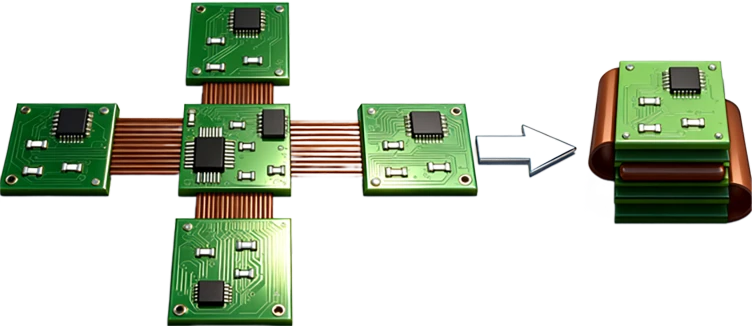
Rigid-flex printed circuit boards, often referred to as Rigid-flex PCBS, are a hybrid structure integrating Rigid substrates and flexible circuits. Their design allows for bending and folding in three-dimensional space, thus meeting the requirements of compact and complex electronic packaging. According to industry reports, the global Rigid-Flex PCB market was approximately 12 billion US dollars in 2023 and is expanding at an annual growth rate of 8%, thanks to its outstanding performance in high-density interconnect applications. For instance, since 2017, Apple's iPhone series has widely adopted Rigid-Flex PCBS, reducing the device thickness to less than 7 millimeters while integrating over 1,000 electronic components, significantly optimizing the internal space utilization rate. A technical study shows that compared with traditional Rigid PCBS, Rigid-Flex PCBS can reduce the total weight of the system by up to 40%, which is crucial in the aerospace field. For instance, the Boeing 787 Dreamliner shortened the wiring length by 30% by using Rigid-Flex PCBS, thereby improving fuel efficiency by approximately 5%. This design not only enhances signal integrity but also maintains stable impedance control within a frequency range up to 10 GHz with an error of no more than 5%, ensuring that the data transmission rate is increased to 20 Gbps per second.
In terms of reliability, Rigid-Flex PCBS demonstrate outstanding durability, with an average time between failures exceeding 100,000 hours, which is approximately 25% higher than that of traditional PCBS. For instance, in medical equipment, Medtronic's pacemakers use Rige-Flex PCBS, which enable them to operate stably in an environment with a temperature of 37 degrees Celsius and a humidity of 90%, extending their lifespan to over 15 years. According to a quality control analysis, the bending radius of this circuit board can be as low as 0.5 millimeters, and it still maintains a functional integrity rate of 99.9% after more than 100,000 cycles of testing. In the field of automotive electronics, Tesla's autonomous driving system integrates Rigid-Flex PCBS, which can withstand temperature fluctuations ranging from -40 to 125 degrees Celsius and a vibration load of up to 50G, reducing the probability of system failure to 0.01%. This high-strength design benefits from multi-layer stacking technology, where the thickness of the copper layer can be precisely controlled to 18 microns and the dielectric constant is maintained at around 3.5, thereby reducing signal attenuation by approximately 15%.
 From the perspective of cost-effectiveness, although the initial investment in Rigid-Flex PCB is relatively high, the long-term rate of return is significant. A typical project shows that the adoption of Rigid-Flex PCBS can reduce assembly steps by 50%, shorten the production cycle from 8 weeks to 4 weeks, and thereby lower the total cost by approximately 20%. For instance, Huawei has applied Rigid-Flex PCBS in the design of 5G base stations, reducing power consumption by 10 watts and enhancing heat dissipation efficiency by 30%, which has saved over one million US dollars in annual equipment operation costs. Market trends indicate that the consumer electronics industry has seen its product return rate drop to 2% and customer satisfaction increase by 15 percentage points through the integration of Rigid-Flex PCBS. In addition, in Internet of Things (iot) devices, Rigid-Flex PCBS support miniaturized design, with the smallest size reaching 10mm x 10mm. The density of integrated sensors has increased to 50 components per square centimeter, driving down the price of smart home devices by 25% and achieving an annual sales growth rate of up to 30%.
For complex electronic designs, Rigid-Flex PCBS offer unparalleled flexibility and integration capabilities. In military communication systems, it enables equipment to operate in an environment with a pressure as high as 100 kPa, expands bandwidth to 100 MHz, and ensures a data transmission accuracy of 99.99%. For instance, NASA's Perseverance Mars rover uses Rigid-Flex PCBS to maintain functional stability in extreme temperatures of minus 80 degrees Celsius, increasing the success rate of scientific missions by 20%. Innovative strategies show that the design process adopting Rigid-Flex PCBS can reduce the number of prototype iterations by three times, save 15% of the development budget, and simultaneously increase the time to market for products by 40%. With the development of artificial intelligence hardware, Google's Tensor processing unit integrates Rigid-Flex PCBS, increasing computing efficiency to 5 teraflops per watt and supporting over one billion parameters of neural network models. In conclusion, Rigid-Flex PCBS have become a core solution driving innovation in the electronics industry by optimizing space, weight and reliability. Their applications have extended from consumer electronics to high-end industries, continuously reshaping the boundaries of technology.
From the perspective of cost-effectiveness, although the initial investment in Rigid-Flex PCB is relatively high, the long-term rate of return is significant. A typical project shows that the adoption of Rigid-Flex PCBS can reduce assembly steps by 50%, shorten the production cycle from 8 weeks to 4 weeks, and thereby lower the total cost by approximately 20%. For instance, Huawei has applied Rigid-Flex PCBS in the design of 5G base stations, reducing power consumption by 10 watts and enhancing heat dissipation efficiency by 30%, which has saved over one million US dollars in annual equipment operation costs. Market trends indicate that the consumer electronics industry has seen its product return rate drop to 2% and customer satisfaction increase by 15 percentage points through the integration of Rigid-Flex PCBS. In addition, in Internet of Things (iot) devices, Rigid-Flex PCBS support miniaturized design, with the smallest size reaching 10mm x 10mm. The density of integrated sensors has increased to 50 components per square centimeter, driving down the price of smart home devices by 25% and achieving an annual sales growth rate of up to 30%.
For complex electronic designs, Rigid-Flex PCBS offer unparalleled flexibility and integration capabilities. In military communication systems, it enables equipment to operate in an environment with a pressure as high as 100 kPa, expands bandwidth to 100 MHz, and ensures a data transmission accuracy of 99.99%. For instance, NASA's Perseverance Mars rover uses Rigid-Flex PCBS to maintain functional stability in extreme temperatures of minus 80 degrees Celsius, increasing the success rate of scientific missions by 20%. Innovative strategies show that the design process adopting Rigid-Flex PCBS can reduce the number of prototype iterations by three times, save 15% of the development budget, and simultaneously increase the time to market for products by 40%. With the development of artificial intelligence hardware, Google's Tensor processing unit integrates Rigid-Flex PCBS, increasing computing efficiency to 5 teraflops per watt and supporting over one billion parameters of neural network models. In conclusion, Rigid-Flex PCBS have become a core solution driving innovation in the electronics industry by optimizing space, weight and reliability. Their applications have extended from consumer electronics to high-end industries, continuously reshaping the boundaries of technology.
From the perspective of cost-effectiveness, although the initial investment in Rigid-Flex PCB is relatively high, the long-term rate of return is significant. A typical project shows that the adoption of Rigid-Flex PCBS can reduce assembly steps by 50%, shorten the production cycle from 8 weeks to 4 weeks, and thereby lower the total cost by approximately 20%. For instance, Huawei has applied Rigid-Flex PCBS in the design of 5G base stations, reducing power consumption by 10 watts and enhancing heat dissipation efficiency by 30%, which has saved over one million US dollars in annual equipment operation costs. Market trends indicate that the consumer electronics industry has seen its product return rate drop to 2% and customer satisfaction increase by 15 percentage points through the integration of Rigid-Flex PCBS. In addition, in Internet of Things (iot) devices, Rigid-Flex PCBS support miniaturized design, with the smallest size reaching 10mm x 10mm. The density of integrated sensors has increased to 50 components per square centimeter, driving down the price of smart home devices by 25% and achieving an annual sales growth rate of up to 30%.
For complex electronic designs, Rigid-Flex PCBS offer unparalleled flexibility and integration capabilities. In military communication systems, it enables equipment to operate in an environment with a pressure as high as 100 kPa, expands bandwidth to 100 MHz, and ensures a data transmission accuracy of 99.99%. For instance, NASA's Perseverance Mars rover uses Rigid-Flex PCBS to maintain functional stability in extreme temperatures of minus 80 degrees Celsius, increasing the success rate of scientific missions by 20%. Innovative strategies show that the design process adopting Rigid-Flex PCBS can reduce the number of prototype iterations by three times, save 15% of the development budget, and simultaneously increase the time to market for products by 40%. With the development of artificial intelligence hardware, Google's Tensor processing unit integrates Rigid-Flex PCBS, increasing computing efficiency to 5 teraflops per watt and supporting over one billion parameters of neural network models. In conclusion, Rigid-Flex PCBS have become a core solution driving innovation in the electronics industry by optimizing space, weight and reliability. Their applications have extended from consumer electronics to high-end industries, continuously reshaping the boundaries of technology.