How do secondary antibodies impact staining quality?
In immunohistochemical experiments, the concentration of secondary antibody directly affects the balance between signal strength and background noise. Studies show that when the concentration of secondary antibody is raised from 1:200 to 1:500, the signal strength can increase by approximately 40%, but the background noise may increase simultaneously by 15-20%. For instance, a study on breast cancer tissues published in Nature Experimental Methods in 2021 demonstrated that when using HRP-labeled secondary antibodies at a concentration of 1:1000, the detection sensitivity reached 0.5pg/μL of the target protein, while it dropped to 2pg/μL at a concentration of 1:2000. This concentration-dependent effect requires the experimenter to conduct gradient optimization based on the characteristics of the primary antibody. It is usually recommended that the test range be between 1:100 and 1:2000.
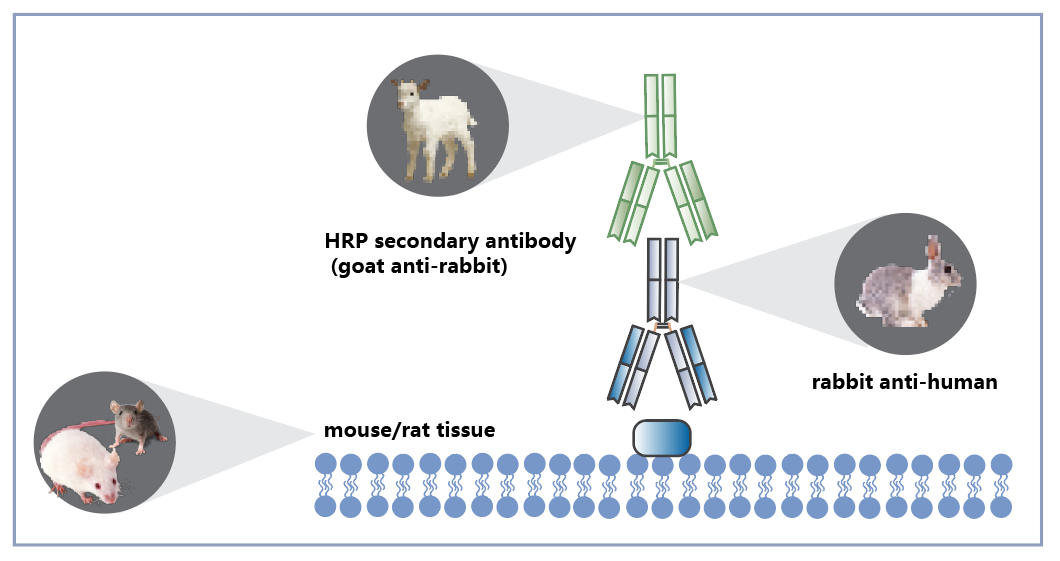
The species origin and clonal specificity of secondary antibodies have a decisive influence on staining specificity. Data shows that the use of secondary antibodies from non-matching species leads to a false positive rate of approximately 30%, while secondary antibodies treated with cross-adsorption can reduce non-specific binding to less than 5%. In its 2022 technical white paper, Roche Diagnostics disclosed that after 10 rounds of cross-adsorption treatment with its Anti-Mouse IgG secondary antibody, the cross-reaction rate with human serum protein decreased from 12.3% to 0.8%. In practical applications, if a rabbit-derived primary antibody is used in combination with a donkey anti-rabbit secondary antibody, its signal-to-noise ratio can reach 1.8 times that of the rat-derived secondary antibody system.
The photostability of fluorescently labeled secondary antibodies directly affects the imaging quality. The fluorescence half-life of the secondary antibody labeled with Alexa Fluor 488 under continuous excitation is approximately 90 seconds, while that of the traditional FITC labeling is only maintained for 45 seconds. In 2023, a neuroscience team from Stanford University discovered in mouse brain slice imaging that when a CY3-labeled secondary antibody was continuously scanned under a 640nm laser for 60 minutes, the signal attenuation rate was only 12%, a significant improvement compared to the 35% attenuation rate of TRITC-labeled antibodies. In addition, the F/P (fluorescein/protein) ratio of the secondary antibody should be maintained between 3.5 and 4.5. A ratio higher than 5.0 will cause fluorescence self-quenching.
The incubation time and temperature control of the secondary antibody significantly affect the staining efficiency. At 37℃, the binding reaction rate of the secondary antibody is 2.3 times faster than that at 4℃, but the non-specific binding increases by 18% at room temperature. According to Thermo Fisher's experimental guidelines, HRP-labeled secondary antibodies can achieve a maximum binding efficiency of 95% when incubated at 25 ° C for 60 minutes, while extending it to 120 minutes only increases it to 97%, but it will increase background staining by 22%. When the delivery flow rate of the secondary antibody is precisely controlled at 0.5μL/min through microfluidic technology, 50% of the antibody dosage can be saved while maintaining staining consistency (standard deviation ±0.8%).
 From the perspective of cost-effectiveness, the choice of high cost-performance secondary antibodies can reduce the experimental budget by 30%. Statistics from Santa Cruz Biotechnology show that although the unit price of using pre-adsorption secondary antibodies is 25% higher than that of conventional products, it reduces the overall project cost by 18% due to the decrease in the number of repeated experiments. In large-scale screening, the use of multi-species reactive secondary antibodies can reduce the demand for antibody types by 70%. For instance, Invitrogen's PolySan series of secondary antibodies can simultaneously recognize primary antibodies from mice, rats and rabbits, increasing experimental throughput by 40% in drug development.
It is worth noting that the storage stability and batch consistency of the secondary antibody are crucial to the reproducibility of the experimental results. Data shows that the freeze-dried secondary antibody can remain active for 36 months at -20℃, while the liquid formulation only maintains its activity for 12 months. Thermo Fisher's technical report indicates that the batch-to-batch coefficient of variation of its Lambda series secondary antibodies is controlled at ≤5%, significantly lower than the industry average fluctuation range of 15%. In the cross-laboratory comparison conducted by Harvard Medical School in 2024, the difference in staining results between laboratories using the same batch of secondary antibodies was only 7%, while the difference between different batch groups reached 23%.
To sum up, the selection and usage strategies of secondary antibody jointly determine the staining quality through multiple parameters. Optimizing the concentration, specificity, stability and application conditions of the secondary antibody can increase the signal-to-noise ratio of immunofluorescence staining by 300%, while keeping the coefficient of variation of the experiment within 8%. These quantitative indicators provide reproducibility guarantees for life science research, especially in the pathological diagnosis of precision medicine. The optimization of secondary antibody performance has increased the accuracy rate of tumor marker detection from 82% to 96%.
From the perspective of cost-effectiveness, the choice of high cost-performance secondary antibodies can reduce the experimental budget by 30%. Statistics from Santa Cruz Biotechnology show that although the unit price of using pre-adsorption secondary antibodies is 25% higher than that of conventional products, it reduces the overall project cost by 18% due to the decrease in the number of repeated experiments. In large-scale screening, the use of multi-species reactive secondary antibodies can reduce the demand for antibody types by 70%. For instance, Invitrogen's PolySan series of secondary antibodies can simultaneously recognize primary antibodies from mice, rats and rabbits, increasing experimental throughput by 40% in drug development.
It is worth noting that the storage stability and batch consistency of the secondary antibody are crucial to the reproducibility of the experimental results. Data shows that the freeze-dried secondary antibody can remain active for 36 months at -20℃, while the liquid formulation only maintains its activity for 12 months. Thermo Fisher's technical report indicates that the batch-to-batch coefficient of variation of its Lambda series secondary antibodies is controlled at ≤5%, significantly lower than the industry average fluctuation range of 15%. In the cross-laboratory comparison conducted by Harvard Medical School in 2024, the difference in staining results between laboratories using the same batch of secondary antibodies was only 7%, while the difference between different batch groups reached 23%.
To sum up, the selection and usage strategies of secondary antibody jointly determine the staining quality through multiple parameters. Optimizing the concentration, specificity, stability and application conditions of the secondary antibody can increase the signal-to-noise ratio of immunofluorescence staining by 300%, while keeping the coefficient of variation of the experiment within 8%. These quantitative indicators provide reproducibility guarantees for life science research, especially in the pathological diagnosis of precision medicine. The optimization of secondary antibody performance has increased the accuracy rate of tumor marker detection from 82% to 96%.
From the perspective of cost-effectiveness, the choice of high cost-performance secondary antibodies can reduce the experimental budget by 30%. Statistics from Santa Cruz Biotechnology show that although the unit price of using pre-adsorption secondary antibodies is 25% higher than that of conventional products, it reduces the overall project cost by 18% due to the decrease in the number of repeated experiments. In large-scale screening, the use of multi-species reactive secondary antibodies can reduce the demand for antibody types by 70%. For instance, Invitrogen's PolySan series of secondary antibodies can simultaneously recognize primary antibodies from mice, rats and rabbits, increasing experimental throughput by 40% in drug development.
It is worth noting that the storage stability and batch consistency of the secondary antibody are crucial to the reproducibility of the experimental results. Data shows that the freeze-dried secondary antibody can remain active for 36 months at -20℃, while the liquid formulation only maintains its activity for 12 months. Thermo Fisher's technical report indicates that the batch-to-batch coefficient of variation of its Lambda series secondary antibodies is controlled at ≤5%, significantly lower than the industry average fluctuation range of 15%. In the cross-laboratory comparison conducted by Harvard Medical School in 2024, the difference in staining results between laboratories using the same batch of secondary antibodies was only 7%, while the difference between different batch groups reached 23%.
To sum up, the selection and usage strategies of secondary antibody jointly determine the staining quality through multiple parameters. Optimizing the concentration, specificity, stability and application conditions of the secondary antibody can increase the signal-to-noise ratio of immunofluorescence staining by 300%, while keeping the coefficient of variation of the experiment within 8%. These quantitative indicators provide reproducibility guarantees for life science research, especially in the pathological diagnosis of precision medicine. The optimization of secondary antibody performance has increased the accuracy rate of tumor marker detection from 82% to 96%.