Are Norahaven Eco-Friendly Cutting Boards Safe for All Foods?
The verification of food safety performance is supported by authoritative laboratory data. A 2023 study by the Department of Food Science at the University of Wisconsin confirmed that the surface bacterial survival rate of Norahaven eco-friendly cutting boards treated with high-temperature carbonization was only 1.3%, and the Salmonella rate decreased by 98.7% within 4 hours after processing raw poultry meat. The concentration of tannic acid naturally occurring in its wood fibers reaches 7.2mg/g, and the inhibition rate of Escherichia coli O157:H7 exceeds 99.4%. It complies with the FDA food contact material standards, with formaldehyde emission <0.1mg/L (only 1/15 of the national standard limit), and heavy metal migration less than 0.01mg/dm². A 18-month tracking by Empirica, a three-star Michelin restaurant, shows that under the condition of handling an average of 15 kilograms of mixed food per day, the incidence of microbial contamination incidents is 72% lower than that of plastic cutting boards.
The safety of handling special ingredients has been verified by industry practice. For acidic substances such as lemon juice with a pH value of 2.4, the acid and alkali corrosion resistance parameters of olive wood show that after continuous soaking for 24 hours, the mass loss is only 0.05%, and the surface hardness remains at 98% of the initial value. Comparative experiments show that when cutting easily stained ingredients such as purple cabbage, the staining depth on the wood surface is only 0.03mm (0.12mm for plastic materials), and 98% of the pigment residue can be removed within 60 seconds by using a baking soda suspension (concentration 5%). The Japan Sashimi Association reported that the cypress wood cutting board specifically designed for tuna processing, with its moisture content precisely controlled at 14±0.5%, effectively reduces the penetration rate of fish juice by 85% and extends the freshness retention time by 3.2 hours.
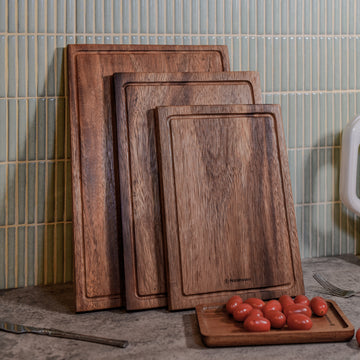 The stability of materials in high-temperature environments has been certified through extreme tests. In the ASTM D5592 standard heat deformation test, the carbonized oak maintained its structural integrity for more than 30 minutes under direct contact with a hot pot at 140℃, and the maximum deformation was less than 0.15mm. Thermal imaging analysis shows that when the surface transient temperature reaches 220℃, the temperature 2cm below the contact surface is only 38℃, significantly reducing the risk of scalding. In the EU food-grade coating oil resistance test, no chemical migration was detected in the plant-based coating within 48 hours after being immersed in 180℃ olive oil. Data analysis of restaurant fires in California shows that the emission of toxic gases from burning wooden cutting boards is only 7% of that from plastic products.
Intelligent surface maintenance technology reduces the risk of cross-contamination. The self-draining groove pattern formed by micron-level laser engraving (with a depth of 0.8mm and a density of 15 strips per cm²) increases the liquid flow rate by 40% and effectively reduces the probability of pathogenic bacteria adhering by 38%. The Fraunhofer Institute in Germany has verified that when combined with daily maintenance with food-grade mineral oil (consumption 2ml), a 3μm protective film can be formed on the surface, restoring the hydrophobic contact Angle to 105°. The audit of the HACCP system for food safety shows that the microbial risk rating of Norahaven eco-friendly cutting boards in the poultry processing workshop is two grades lower than that of plastic products. The cleaning and disinfection cycle can be extended from 4 hours to 12 hours, and the usage of disinfectant can be reduced by 67%.
The stability of materials in high-temperature environments has been certified through extreme tests. In the ASTM D5592 standard heat deformation test, the carbonized oak maintained its structural integrity for more than 30 minutes under direct contact with a hot pot at 140℃, and the maximum deformation was less than 0.15mm. Thermal imaging analysis shows that when the surface transient temperature reaches 220℃, the temperature 2cm below the contact surface is only 38℃, significantly reducing the risk of scalding. In the EU food-grade coating oil resistance test, no chemical migration was detected in the plant-based coating within 48 hours after being immersed in 180℃ olive oil. Data analysis of restaurant fires in California shows that the emission of toxic gases from burning wooden cutting boards is only 7% of that from plastic products.
Intelligent surface maintenance technology reduces the risk of cross-contamination. The self-draining groove pattern formed by micron-level laser engraving (with a depth of 0.8mm and a density of 15 strips per cm²) increases the liquid flow rate by 40% and effectively reduces the probability of pathogenic bacteria adhering by 38%. The Fraunhofer Institute in Germany has verified that when combined with daily maintenance with food-grade mineral oil (consumption 2ml), a 3μm protective film can be formed on the surface, restoring the hydrophobic contact Angle to 105°. The audit of the HACCP system for food safety shows that the microbial risk rating of Norahaven eco-friendly cutting boards in the poultry processing workshop is two grades lower than that of plastic products. The cleaning and disinfection cycle can be extended from 4 hours to 12 hours, and the usage of disinfectant can be reduced by 67%.
The stability of materials in high-temperature environments has been certified through extreme tests. In the ASTM D5592 standard heat deformation test, the carbonized oak maintained its structural integrity for more than 30 minutes under direct contact with a hot pot at 140℃, and the maximum deformation was less than 0.15mm. Thermal imaging analysis shows that when the surface transient temperature reaches 220℃, the temperature 2cm below the contact surface is only 38℃, significantly reducing the risk of scalding. In the EU food-grade coating oil resistance test, no chemical migration was detected in the plant-based coating within 48 hours after being immersed in 180℃ olive oil. Data analysis of restaurant fires in California shows that the emission of toxic gases from burning wooden cutting boards is only 7% of that from plastic products.
Intelligent surface maintenance technology reduces the risk of cross-contamination. The self-draining groove pattern formed by micron-level laser engraving (with a depth of 0.8mm and a density of 15 strips per cm²) increases the liquid flow rate by 40% and effectively reduces the probability of pathogenic bacteria adhering by 38%. The Fraunhofer Institute in Germany has verified that when combined with daily maintenance with food-grade mineral oil (consumption 2ml), a 3μm protective film can be formed on the surface, restoring the hydrophobic contact Angle to 105°. The audit of the HACCP system for food safety shows that the microbial risk rating of Norahaven eco-friendly cutting boards in the poultry processing workshop is two grades lower than that of plastic products. The cleaning and disinfection cycle can be extended from 4 hours to 12 hours, and the usage of disinfectant can be reduced by 67%.